
If you’re a sales manager handling a great team, selling an awesome product and still not hitting the numbers; let me paint a picture. Your team is performing various activities each day, across accounts and deals. The only metric tracked is the number of closed deals and their value. There is no understanding of the number of activities performed by the salesperson on a daily basis. The revenue produced by the team is dipping, and no one has a clue as to why.
Does this sound familiar? If yes, the team needs a sales process, and not just any sales process . but the one customised to their needs, the product and the market..
It is hard to analyse team performance if there are no activity metrics available. If you wish to understand how to take a deal forward, there has to be a set process which explains each stage of the process. Each salesperson should be accountable for sticking to the process and guiding the customer through a sale. With a process in place, it is easier to analyse bottlenecks and understand how each bottleneck could be tackled.
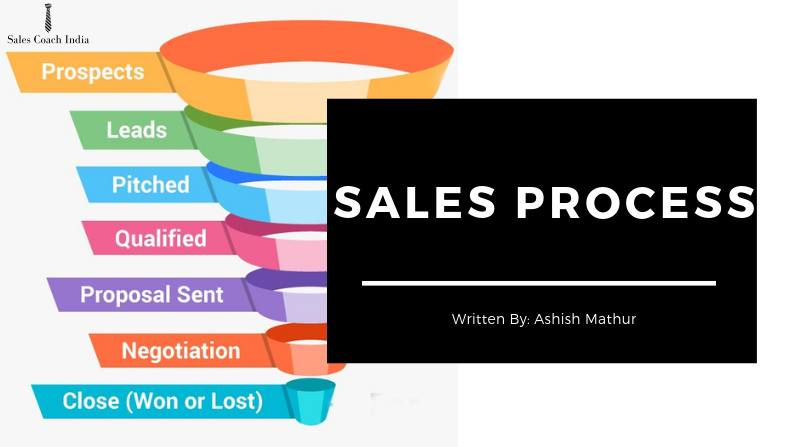
A systematic selling process consists of following ten steps as shown in the diagram:

1. PRE-SALES PREPARATION:
Pre-Sales is the first step of getting prepared to serve customers. A good salesperson must be well prepared to treat the customer effectively. He must be aware of the customer’s buying motives and buying behavior. We have in our earlier blogs already covered that the following essentials of selling must be fully known to him-
About Himself
About The Company
About The Product
About The Market
About The Competition.
2. PROSPECTING:
Prospecting means finding or locating potential customers. It is a process of differentiating prospects and suspects. A prospect is a potential buyer with unmet needs, ability to pay and willingness to buy. It is much easier to prospect for the right customer if you have a marketing plan that determines your target market.
There are three different segments of people in the world of prospecting-
People you don’t know
- Social media
- Network events
- Cold market prospecting
- Friendship farming
- Centers of influence
- Other salespeople
- Use of telephone directories and directories of professional and other associations
- Customer database available, prepared by other companies or agencies.
People you do know
- Your existing customers
- Your past customers
- Shortlisted prospects through cold calling
- Follow up on old leads that never closed.
People your people know
- Data of prospects at HO
- Data of prospects with your Team
- Enquiries sent by prospects either to HO or Team.
One must qualify the prospect in terms of needs, purchasing power and motivation to buy.
3. PRE-APPROACH:
Once prospecting has been done, the
4. APPROACH & CONTACT:
Now that the
5. PRESENTATION:
A formal sales presentation must get
Leaks in your presentation– Talking too much and not asking enough questions. If it’s too many statements without questions, you’re not a good presenter. A good presenter is somebody that’s asking relevant questions because you get to find about the customer and his buying needs.
He can produce authentic
Qualities of a good presentation:
Presentation is questions and knowing your craft, knowing your product and generally not B sing people whom you don’t know what you are talking about.- Sales Presentation must be
complete covering all aspects related tocompany , product, competitive benefits, etc. - Sales Presentation must be clear, free from all confusions and vagueness.
- Sales Presentation must be consistent.
- Sales Presentation must be precise.
- Sales Presentation must prove
superiority of products overcompetition . - Sales Presentation must be
confidence winning. - Sales Presentation must be supported with
evidences . A goodsales person must produce testimonials, awardsand guarantees issued by government or test labs, celebrities, and other reliable sources.
Be well prepared– Prepare, prepare, practice, practice and then practice more for an effective presentation. You only have one shot at making a first impression.
6. HANDLING OBJECTIONS & COMPLAINTS:
Address any concerns or objections the prospect may have. Again be prepared- Objection Handling is a step by step process that we shall take up separately in one of my future
A good
7. CLOSING SALES:
8. FOLLOW UP:
Follow up is a simple two-step process-
- Completion of selling formalities
- Taking other post-sales actions.
A salesperson writes order, arranges for dispatch and delivery of the product and decides on the mode of payment. Billing and guarantee cards are issued. Follow up is 100% discipline-Details are equally important. Details are important as, if you don’t remember the conversation you had with the customer in the first meeting, reflects you do not pay attention to things. But if you do have the discipline to follow up and you do remember the specific details you had with the customer in the first meeting, reflects you value his time.
9. REFERRAL:
Once you have closed sales- do not celebrate. Ask for referrals. Preparing a script for asking for referrals is also important. Asking for referral is setting yourself up for growing your business.
10. MAINTAIN CUSTOMER RELATIONSHIP:
Sales person-customer relationship does not end with one transaction, but is the beginning of a long term relationship. Customers repeat orders only if they are satisfied with products and post-sales services. A great sales person must remain in live contact with the customer for future business.
Studies have proved that if you sell out of sequence, you kill the sale. There is a logical buying process that a customer goes through. You have to get your selling process in line fitting the buying process and the sale is bound to happen.


