9826084669
KNOWING YOUR PRODUCT

KNOWING YOUR PRODUCT

One of the key essential of Selling is “Knowing your Product”. The best way to do this is to ask yourself a few questions that will give you a kick start to the process-

  1. What is your product?
  2. What does it do?
  3. What solution/benefit does it provide to the customer?
  4. Why is there a need for this product?
  5. Why is your product superior to those similar to it?
  6. What benefits does your product offer that other companies with a similar product do not?
  7. Who is your target buyer?
  8. What problems are you solving for people with this product?

Understanding your product’s features allows you to present their benefits accurately, persuasively, confidently and with conviction. Customers respond to enthusiastic sales people who are passionate about their products and eager to share the benefits with them.

Use all relevant sources of information to learn about your products and services including:

  • Your own experiences using the products
  • Product literature such as catalogs and brochures
  • Online forums
  • Feedback from customers
  • Trade and industry publications
  • Internal sales records
  • Your own Team Members
  • Visit to manufacturers
  • Sales Training Programmes
  • Competitor information
  • Testimonials
  • Role Playing

It is important to “Communicate” with the customer instead of just “Talking”. Communicating is selling Benefits and not the Features. The success of a sales call depends upon your ability to communicate effectively how the benefits of your product or service will satisfy your customers.

Product Benefits are the links between your Product’s Features and your Customer’s Needs. You satisfy your customer’s needs by translating features of your product into specific benefits. To practice this skill, prepare a FAB Chart for your products.

FEATURE: A characteristic of a product or service (Anything that describes it).

ADVANTAGE: A general usefulness of a product or service to all people derived from this feature. It should answer to the question- “So what” about the feature.

BENEFIT: A special usefulness of a product or service. The way in which the advantage satisfies an individual’s specific need. It should answer to the question-“How do I (the customer) benefit from this advantage”?
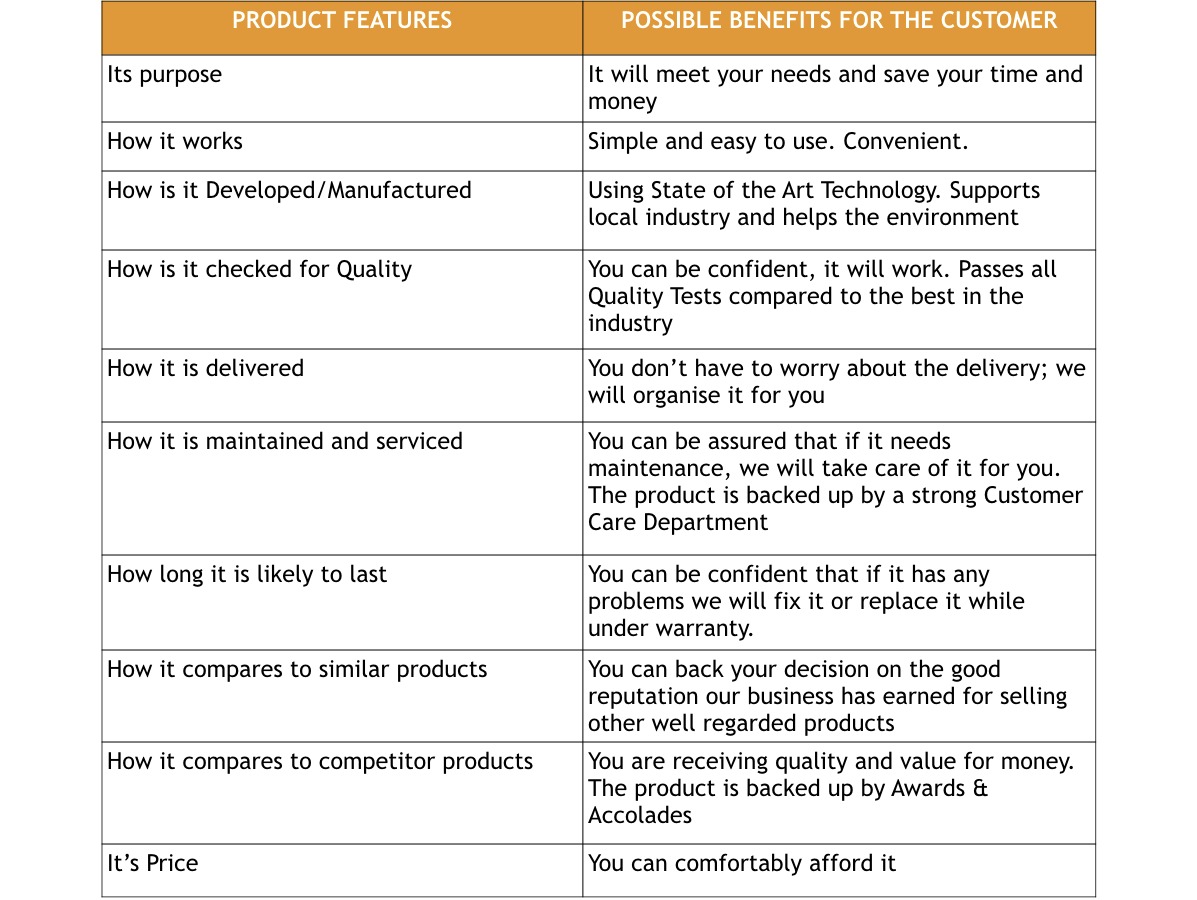
Customers look for product knowledge. It helps them in their buying decisions. It’s how they trust you as a Sales Person. But remember, using product knowledge is a skill. Do not overuse it. Only talk about the benefit that satisfies customer’s need. The customer needs to feel that you have their best interest at heart and not putting on a show of your great intellect. 

Knowing Your Company

Knowing Your Company

In my last blog, we had discussed and elaborated on the first essential of selling- “knowing yourself”.

Let us now discuss the second essential of selling:

“Knowing Your Company”.

Successful Salespeople know all about their company. They are aware of their company’s capabilities. They have an understanding of their company’s products, their service offerings, features, advantages, and benefits of their products. This knowledge is essential to present ideas and solutions to customers.

They should have a clear understanding of their company’s “Goal” and “Vision”. Customers do not want to associate with your company just because what your company does. They want to be a part of why your company does it. They want to do business with people who believe what they believe.

This cannot be effectively communicated unless you know your company and its authenticity. Better knowledge of your company will give you confidence and conviction, will make your communication richer, of higher quality and more effective. Once you are able to do that, you’ll attract loyal, belief-driven customers that can build an organization’s future.

Successful Salespeople spend time knowing about their company, their business, and the competitive landscape. If they do not have an understanding of their company’s business, how and where is their company placed against competition in the market, they will always struggle to make sales. They will surely land up in one of the following situations:

  1. Identifying and  Approaching a wrong prospect,
  2. Approaching prospects that their business can’t legitimately serve or
  3. They fail to answer their prospect’s queries that allow the prospect to overlook them and go to the competition.

Let us now ask ourselves some questions, intellectual and factual, as to how well do we know our company.

FACTUAL

  1. Product lines of your company (if the company has more than one product line and you are not a part of others, still you should know about them)
  2. Organization hierarchy and Organization Chart
  3. Company Financials (Turnover, Net Revenue, Net Profit, Share Price, etc.)
  4. Number of employees
  5. History
  6. Production Facilities
  7. Daily Output
  8. Awards & Accolades
  9. Certifications & Affiliations

INTELLECTUAL

  1. Are you aware of your company’s business beyond the features and benefits of your products?
  2. Do you understand your company’s strategies and how it plans to place itself against the competition?
  3. What are your company’s
  • Goal?
  • Values? And
  • Mission?     

Once the Sales Person has complete details about the company’s history,goodwill and reputation,achievements, objectives and company policies, he qualifies himself to move forward to learn about the 2nd part of the second essential “Knowing your Product”. We would elaborate on this aspect in my next blog, next Tuesday….

Till then Keep Learning….Keep Practicing…

PS: Do let me know what new you learned about your company. Also, share it with all your team members, it will help them all.

THE FOUR ESSENTIALS OF SELLING & “YOU”

THE FOUR ESSENTIALS OF SELLING & “YOU”

You will agree with me that with changing times, organisations have also changed their business models. They have changed to remain profitable in this new business environment. It is time for the Sales Person too, to come out of his “Comfort Zone” and manage the change effectively.

Moving out of our comfort zones involves discomfort and risk. Comfort zones can be seen in our relationships, in our mindsets and in the way we do things. However, change is inevitable and you must take it by the horns. “THE ONLY THING THAT DOES NOT CHANGE IS CHANGE ITSELF”. So, as a Sales Person, we need to change with changing times, equip ourselves with new skill sets and develop ourselves.

This blog is dedicated to sales professionals who have just started their journey in sales and to those who would like to brush up the basics and come out of their comfort zones.  

What are ”The Four Essentials of Selling”?


  • KNOWLEDGE OF SELF-“THE SALES PERSON”
  • KNOWLEDGE OF THE COMPANY, PRODUCTS, MARKET, CUSTOMERS, AND COMPETITORS
  • KNOWLEDGE OF THE SALES PROCESS
  • KNOWLEDGE OF SELLING SKILLS

Let me elaborate on the first essential i.e., Knowledge of Self as a Sales Person. In my last blog, we had discussed that today’s Sales Person has to be a Marketing Expert, a Prospector, a Time Manager, a Profit Centre and a Consultant. But before imbibing these qualities, let us first understand the basic requirements for a successful sales person.

nowledge: Product/Company/Competition/Customer/Market

bility

kills

abits


P lanning

R esourceful

O ptimistic

F ollow the Right Path

I maginative

T actful

You will agree thatKASH and PROFIT is the Blood Line for any business to run smoothly.

NON NEGOTIABLE TRAITS OF A SUCCESSFUL SALESPERSON

The Art and Ability of:

  • Communication
  • Motivation
  • Counseling and Servicing the Needs of the Customers
  • Negotiation
  • Prospecting and gaining Market Information
  • Gather technical and appealing product facts.
  • Understanding “Body Language”
  • Act and React confidently in all situations
  • Solve Problems and make Right Decisions
  • The Wisdom to Think and Act Affirmatively
  • The Mental Alertness to grasp Opportunities quickly


DEVELOPING YOUR SALES PERSONALITY:-

You can do this by systematically acquiring HABITS that enhances the impact of your Sales Personality. This can be done by acquiring the following habits:

  • Modest Manners and Language: Use of phrases like “as you know”, “as you say”. Give information to the customer in a face-saving manner. Be modest.
  • Form Eye Contact Habits: that expresses sincerity and Desire to Help – Belief You Can Help. Also just being sincere is not enough- you must signal your sincerity also.
  • Courtesy Habits that signal Respect: As you know, the word courtesy has been derived from the word “court”. In the modern context, the Customer is the King. King Customer has in his hand the Order.
  • Warmth in your voice that conveys friendliness: Your approach with the customer has to be of friendliness. The customer must feel that you have come to him:
    • For his benefits
    • As a friend
  • Cool-Calm-Collected that conveys confidence: Do not have habits like shaking your legs or playing around with your fingers, a key chain, a pen or drumming with your fingers (these habits indicate a lack of confidence and nervousness).
  • Form Animation Habits to convey enthusiasm: Modulate your voice to emphasise certain words. Use your hands expressively in a powerful manner which helps you bring more sales.
  • Form Promise keeping Habits that signal Reliability and Credibility: Follow up with your customers regarding the promises you have made to them. Each Customer thinks that the Sales Person has made the following 3 promises even though the Salesperson might not have said it aloud:
    • Right goods will be delivered
    • The goods will be delivered on time
    • The goods will do what they are supposed to do.

Besides, a successful Sales Person must also possess:

  • Positive Approach
  • Positive Attitude
  • Discipline
  • Strategies
  • “YOU” Factor

DONT’S FOR A SUCCESSFUL SALES PERSON:-

  • Ridiculing and Underestimating others
  • Argument
  • Clumsy attempts at Humour
  • Laziness
  • Impatience

WHAT DOES A CUSTOMER EXPECT OUT OF YOU?

  • Brisk
  • Crisp
  • Honest

WHAT DOES THE CUSTOMER DISLIKE?

  • Teacher
  • Cheater


Thank you for reading till here. I would now like you to pause and think. Assess what you are best at and where you fall short on the qualification parameters of a SUCCESSFUL SALES PERSON…

IT IS NEVER TOO LATE…..

In the next blog together we will unfold the second essential of selling which is KNOWLEDGE, in fact just Company Knowledge. Stay tuned.

In the meantime, if you have any recommendations or suggestions, feel free to drop them in the comments section below and I will personally attend to it.

See you next Tuesday!

Changing Dynamics Of Sales

Changing Dynamics Of Sales

In today’s competitive and global business environment, knowledge is recognised as one of the most important strategic assets. Knowledge gives confidence and confidence gives a conviction.

Everyone is selling. Each day we spend maximum efforts in selling ourselves and our company’s product or services. But in today’s competitive market, you have to sell better than ever before.

The customers today are better informed and even competitors have become stiffer and more knowledgeable.

In today’s changed sales scenario, you have less and less time to spend with your customers. In fact, surveys indicate that a salesperson today, on an average, spends only two and a half hours a day in front of the prospects. The balance time is spent traveling, waiting, doing paperwork and other job-related tasks.

Obviously, you have to make every minute spent with the prospect count. The more skilled you are, the more sales happen. The increased sales result in more satisfied customers for your company and more success for you.


You have to hone your set of selling skills continuously and consciously and develop yourself. Today’s Sales Person has to be a Marketing Expert, a Prospector, a Time Manager, a Profit Centre, and a Consultant. You must be a Problem Solver not only for your company but also for your customer.  Both you and your customer have needs that can be satisfied with a successful sales interaction.

There is no one fixed formula for a successful need satisfaction selling. The only rule for a successful salesperson is “Flexibility”. With constantly changing needs, ideas and attitudes, problems also tend to change along with schedules, finances, and priorities.

A professional and a successful salesperson must, therefore, be prepared and flexible with his set of selling skills.

The world today is full of “Sales Coaches” and the internet has no shortage of sales blogs either. However, where everyone is riding the wave of service and social selling, the huge market of “Product Sales” is left unattended.

e-commerce and social selling have given new meaning to product sales when we talk about products like clothing, accessories, cosmetics and even these days pharmaceuticals. But that is just one tiny side of the humungous sales these businesses do.

The case sales percentage of product companies lies still in the world of offline sales and that is one art I have mastered in 28 years of working in offline sales in different capabilities, diverse industries, product segments and market areas all across the country.

With this blog I would like to contribute to the present generation of salespeople, different attributes, processes, and techniques, which would help them to sell more and master “The Art of Selling”.


In my next blog, I shall cover “The Four Essentials of Selling” that would just be a tip of the iceberg. These “Essentials” would be elaborated in my future blogs.

In the mean time if you have any feedback, comment, or request which you would like me to consider next, do drop me a line at [email protected] or simply comment below.