by admin | Jan 29, 2019 | Aarambh, Prachand, Sales, Uncategorized
If you’re a sales manager handling a great team, selling an awesome product and still not hitting the numbers; let me paint a picture. Your team is performing various activities each day, across accounts and deals. The only metric tracked is the number of closed deals and their value. There is no understanding of the number of activities performed by the salesperson on a daily basis. The revenue produced by the team is dipping, and no one has a clue as to why.
Does this sound familiar? If yes, the team needs a sales process, and not just any sales process . but the one customised to their needs, the product and the market..
It is hard to analyse team performance if there are no activity metrics available. If you wish to understand how to take a deal forward, there has to be a set process which explains each stage of the process. Each salesperson should be accountable for sticking to the process and guiding the customer through a sale. With a process in place, it is easier to analyse bottlenecks and understand how each bottleneck could be tackled.
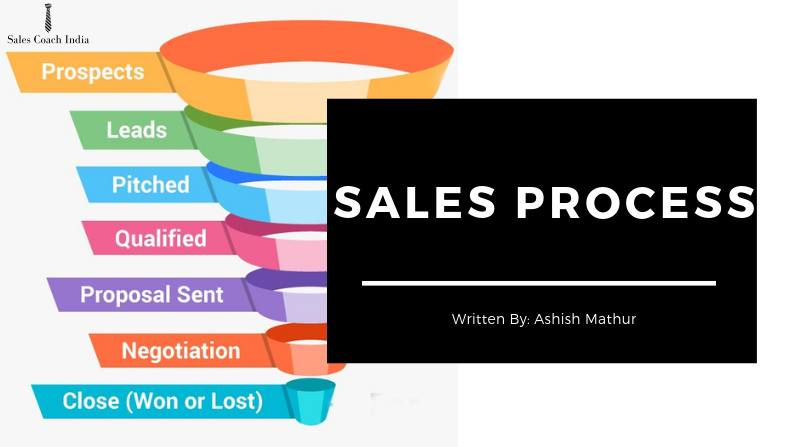
A systematic selling process consists of following ten steps as shown in the diagram:
1. PRE-SALES PREPARATION:
Pre-Sales is the first step of getting prepared to serve customers. A good salesperson must be well prepared to treat the customer effectively. He must be aware of the customer’s buying motives and buying behavior. We have in our earlier blogs already covered that the following essentials of selling must be fully known to him-
2. PROSPECTING:
Prospecting means finding or locating potential customers. It is a process of differentiating prospects and suspects. A prospect is a potential buyer with unmet needs, ability to pay and willingness to buy. It is much easier to prospect for the right customer if you have a marketing plan that determines your target market.
There are three different segments of people in the world of prospecting-
People you don’t know
- Social media
- Network events
- Cold market prospecting
- Friendship farming
- Centers of influence
- Other salespeople
- Use of telephone directories and directories of professional and other associations
- Customer database available, prepared by other companies or agencies.
People you do know
- Your existing customers
- Your past customers
- Shortlisted prospects through cold calling
- Follow up on old leads that never closed.
People your people know
- Data of prospects at HO
- Data of prospects with your Team
- Enquiries sent by prospects either to HO or Team.
One must qualify the prospect in terms of needs, purchasing power and motivation to buy.
3. PRE-APPROACH:
Once prospecting has been done, the sales person has to gather complete details about the prospect. These details are necessary to prepare his sales presentation. These would include information on prospect’s nature, needs, problems, personal habits, preferences, etc.
4. APPROACH & CONTACT:
Now that the sales person is prepared with his pre-approach, he has to seek advance appointment for the personal meeting. The approach could be different on case to case basis. Having a script for an approach call is a MUST. He must not directly jump to sales talk in the approach call. He must be able to attract the prospect’s attention and get him interested in the product.
5. PRESENTATION:
A formal sales presentation must get attention of the prospect and make him interested in the product. The sales person can do it through a lively and interesting sales talk as well as a systematic demonstration of the product. The product could be offered to feel, taste or smell depending on the nature of the product.
Leaks in your presentation– Talking too much and not asking enough questions. If it’s too many statements without questions, you’re not a good presenter. A good presenter is somebody that’s asking relevant questions because you get to find about the customer and his buying needs.
He can produce authentic evidences to prove the product’s superiority. All queries must also be adequately solved.
Qualities of a good presentation:
- Presentation is questions and knowing your craft, knowing your product and generally not B sing people whom you don’t know what you are talking about.
- Sales Presentation must be complete covering all aspects related to company, product, competitive benefits, etc.
- Sales Presentation must be clear, free from all confusions and vagueness.
- Sales Presentation must be consistent.
- Sales Presentation must be precise.
- Sales Presentation must prove superiority of products over competition.
- Sales Presentation must be confidence winning.
- Sales Presentation must be supported with evidences. A good sales person must produce testimonials, awards and guarantees issued by government or test labs, celebrities, and other reliable sources.
Be well prepared– Prepare, prepare, practice, practice and then practice more for an effective presentation. You only have one shot at making a first impression.
6. HANDLING OBJECTIONS & COMPLAINTS:
Address any concerns or objections the prospect may have. Again be prepared- Objection Handling is a step by step process that we shall take up separately in one of my future blog. A sales person, however, must always welcome objections as it shows that customer is interested in the products and is more likely to place an order.
A good sales person must interpret objections clearly and remove them tactfully. Unless the objections and complaints are satisfactorily answered, the sales cannot take place. Prospects must be convinced about benefits, superior performance and strong aspects of the products. A great deal of expertise, experience, skills, patience and practice are important to handle objections successfully.
7. CLOSING SALES:
Closing of sales is the climax or the desired outcome of the entire sales process. Sales Process must end by getting orders. A successful sales person MUST close the sale. He should not wait for the customer to ask for the product-that will never come. He has to “ASK” for the order. A good sales person must summarize what the customer has purchased and agree the deal.
8. FOLLOW UP:
Follow up is a simple two-step process-
- Completion of selling formalities
- Taking other post-sales actions.
A salesperson writes order, arranges for dispatch and delivery of the product and decides on the mode of payment. Billing and guarantee cards are issued. Follow up is 100% discipline-Details are equally important. Details are important as, if you don’t remember the conversation you had with the customer in the first meeting, reflects you do not pay attention to things. But if you do have the discipline to follow up and you do remember the specific details you had with the customer in the first meeting, reflects you value his time.
9. REFERRAL:
Once you have closed sales- do not celebrate. Ask for referrals. Preparing a script for asking for referrals is also important. Asking for referral is setting yourself up for growing your business.
10. MAINTAIN CUSTOMER RELATIONSHIP:
Sales person-customer relationship does not end with one transaction, but is the beginning of a long term relationship. Customers repeat orders only if they are satisfied with products and post-sales services. A great sales person must remain in live contact with the customer for future business.
Studies have proved that if you sell out of sequence, you kill the sale. There is a logical buying process that a customer goes through. You have to get your selling process in line fitting the buying process and the sale is bound to happen.

by admin | Jan 22, 2019 | Aarambh, Prachand, Sales, Uncategorized
Companies may have all ingredients of a mega block buster- clear strategic direction with a great vision, a great product line, competitive prices, the best of positioning and yet it’s growth goals are being constrained by a lack of revenue. Revenue is directly related to sales. .
It’s imperative to find out the source of that problem. Is the sales process flawed? Is there a gap between decisions and execution by the sales team?
The next step is identifying inefficiencies and gaps in the sales process and then training the sales team to overcome these inefficiencies as per their training needs.
Training is the process of increasing knowledge, skills and other traits of an individual for performing a particular job. It’s purpose is to improve the behavior and performance of the trainees.
CONCEPT OF SALES TRAINING
Sales Training can help aspiring sales persons to develop and practice the skills they need to succeed and increase their confidence level.
Businesses have realized the importance of sales training and it’s global market has significantly increased over the years.
The learning objectives of effective sales training programs are generally to improve the relationship between sales professionals and their prospects/customers, and to also improve the sales performance and close rates of sales professionals.
TARGET AUDIENCE (WHO?)
Students of sales training programs are primarily those who work as sales professionals, sales managers, channel sales professionals, product sales professionals, and sales force automation professionals.
THE HOW OF SALES TRAINING
Sales training programs often include topics related to customer relationship management, better understanding customer needs, enhancing communication with customers and improving customer interactions.
- SALES METHODOLOGY TRAINING includes basic communication skills and techniques for sales professionals. the most commonly taught sales methodologies are Spin Selling and Solution Selling.
- SALES MANAGEMENT TRAINING involves skills for how to manage a sales force..
- PRODUCT SALES TRAINING involves knowledge of the products/services the sales professional is selling. A common approach to product sales training is teaching how to communicate the features, advantages and benefits (FAB) of the product to the customer.
- SALES FORCE AUTOMATION involves teaching the sales professionals how to use online tools to track and report the progress of sales activities.
IMPORTANCE OF PROFESSIONAL SALES TRAINING:
PROPER AND A PROFESSIONAL SALES TRAINING IS IMPORTANT FOR A NUMBER OF REASONS:
- IMPROVING COMMUNICATION SKILLS
- LEARNING SALES METHODOLOGY
- OVERCOMING OBJECTIONS
- DEVELOPING ADMINISTRATIVE SKILLS
- PRODUCT KNOWLEDGE
- CUSTOMER SERVICE SKILLS
OBJECTIVES OF SALES TRAINING:
- SALES GROWTH & INCREASED PRODUCTIVITY (SALES PRODUCTIVITY, INCREASED SALES & PROFITS OR BOTH)
- SALES FORCE TURNOVER (TO CREATE POSITIVE ATTITUDE AND TO INCREASE SALES FORCE MORALE)
- REPEAT CUSTOMERS (TO IMPROVE CUSTOMER RELATIONS)
- UP SELL STRATEGIES
- SALES EFFECTIVENESS
- TO INTRODUCE NEW PRODUCTS, MARKET AND PROMOTIONAL PROGRAMS.
THE BEST SALES PEOPLE HAVE The DRIVE TO LEARN AND BE THE BEST.
GOOD SALES TRAINING WILL HELP THEM GET THERE.
INVEST IN IT EARLY ON AND YOU’LL HAVE A TEAM THAT CAN’T BE BEAT.

by admin | Jan 15, 2019 | Aarambh, Prachand, Sales, Uncategorized
Making a career choice is one of the most critical decision one takes that will shape their entire life. Whether you have already chosen sales as your choice of career or you are considering it, here are a few things which will help you make an informed decision.
Spoiler Alert – Sales is not for the faint-hearted.
Life goes on. It simply passes by. We are all to finally fade. But for some amongst us, it is different. For us, life throws up opportunities. Excellence in business is one such opportunity and selling is business.
Selling is an art and like any other performing art, we have a performer- the salesperson and a beholder- the prospect. As an old proverb goes, “Every successful person is a good salesperson”. One can assume that selling comes naturally to some people. But then, how many of us are conscious of the fact that we are good salespersons. To sell naturally is something, but to sell compulsively and effectively is a different proposition. One does need professional skills to sell.
Let us first learn abut the territory we are getting into – sales.
What is selling?
Selling primarily effects transfer of Products and Services for something in exchange-from one person to another. It is a fair Exchange for the satisfaction of Mutual Needs. The Customer’s need for a Product or Service is satisfied by the Sales Person & His organization. In turn, the salesperson gets Business & Profit which is his need.
- Both the Buyer & seller thus have their need satisfied.
- In selling make sure your customer gains so that you also gain.
Any selling activity can be divided into various stages and various sequences and models. The performer has to practice a lot and sharpen his/her skills to avoid chaos during a sales call.
It is elementary that a salesperson gathers complete details of a client and specific requirements.
The significance of gaining the attention of the beholder is the first step in selling.
Building up of interest comes next after having gained attention. Before you give your prospect an optimum exposure of your product knowledge, identify his needs for him and then propose your product or services for him. Create a desire for your products or services. Arouse him. Bring in conviction. Talk of opportunity lost. Bring at a price only if you have to. Timing is important.
Thus, for a successful sales call following is important:
- Attention
- Interest- problem identification & classification
- Desire
- Conviction
- Close
Why Sales?
More and more young people are taking up sales as their career. That one has a knack of initiating a dialogue with anybody anywhere is not the only credential of a salesperson. One has to be initiative and imaginative. Above all one has to develop the skill of being a good listener. Experience teaches all that, plus the ability to give direction to a conversation. Lead the conversation to your goal without diluting the main purpose one bit.
Selling as a career gives you:
- Freedom of expression
- Offers you an opportunity to become successful
- Offers you a challenge every day, at every step, and stimulates you regularly
- Offers rich and high rewards
- Stimulates your personal growth
- Master of your own.
While the emotional rewards range drastically from sales job to sales job, the thrill of victories, the income rewards, the flexibility associated with sales and the learning potential makes choosing a career in sales a very attractive option but yet, not for the faint hearts.

by admin | Jan 8, 2019 | Aarambh, Prachand, Sales, Uncategorized
To understand the strengths of your products better, you must understand your competition and your positioning. What are your competitor’s strengths and weaknesses will give you a better understanding of your positioning in the market?
Why do people buy your products or services instead of others offered in the same category? What benefits do you offer at what prices, to whom, and how does your mix compare to others? Competitive analysis has become an essential part of business marketing activity and strategic planning.
What does a successful salesperson look for about competition?
- Product and services and how do they sell them.
- Product Pricing.
- Discounting structure.
- Distribution and delivery.
- Customer schemes.
- Innovation in products and business strategies.
- The number of employees and their expertise.
- Usage of new technologies.
- Hierarchy of employees.
- Annual performance.
- Marketing activities.
It is of utmost importance to gather information not only about your competitors but also of their customers.
- Who are your competitor’s customers?
- What products do the customers purchase in the market?
- The strengths and weaknesses the customer sees in your competitor.
- Who are your competitor’s target customers and markets?
How does a successful salesperson use this information?
The information gathered on the competition needs to be evaluated first. This evaluation will reveal if there is any gap your competition has overlooked. This gap needs to be exploited.
Finding information on competitors
You can find a lot of information and market data on the Internet. Company Website provides a lot of useful information. Industry associations, industry publications, media coverage, information from financial communities, and their own marketing materials may also be a good resource to identify the performance and position of each competitor.
Make a list of information that you have gathered for all your competitors. List down the strengths and weaknesses of each of them against yours. Categorize this information. Find out what you can learn from your competitors. Can you do something better than what they are doing? Learn about their best practices which could be adopted and also their negatives that could be left alone.
This is one reason why athletes and coaches watch hours and hours of videos about their competitors or opponents. They do this in order to find out their weaknesses and strengths and how they could be exploited. This is exactly what you have to do as a salesperson.
Competition is good. It makes us better. It keeps us on our toes. Competition creates better products. Competition keeps you active and dynamic and competitors push you to achieve more.

by admin | Jan 2, 2019 | Aarambh, Prachand, Sales, Uncategorized
My last blogs emphasized that in the changing dynamics of sales, a salesperson to be successful is required to continuously develop his skill sets. To master the “Art of Selling”, you should know all the essentials of selling. We have already elaborated on Knowing Yourself, knowing your Company and the Product.
“Knowing your Market” is a key essential of selling. Your market includes your customers, your suppliers, and your competitors. These are pivotal characters that define the success of your business. To know your customer’s likes and dislikes, their spending power, what they enjoy and what they need, will give you a clear picture of what your customer wants from you. This will enable you to translate your product into something that will sell to your target market.
Usually, a market analysis includes a view of the industry you are in. You must be aware of the industry trends, industry growth, recent developments and common keys to success. You should be doing a good web search for available information that might come from market studies, trade associations, industry experts, blogs, major competitors and local competitors and of course, the actual ground-work survey.
Knowing your market includes:
-
“Total Addressable Market” or “Total Available Market” (TAM): It is the entire potential market available. It’s large and usually a useless number.
-
“Serviceable Available Market” (SAM): It is a more useful number that can be reached and serviced.
-
“Share of Market” (SOM): You must target a definite percent of market share you intend to capture of the total serviceable available market.
In today’s scenario, having a well-defined target market is a ‘MUST’. You cannot service the entire available market. Target marketing allows you to focus on a specific market that is more likely to buy from you than the other markets. Here is how you may define your target market-
-
Look at your current customer base: Who are your current customers and why do they buy from you. These factors could be used to influence new customers as well.
-
Check out your competition: Who are your customers targeting? Who are their current customers? You may not necessarily target the same set of customers but can find out who are they overlooking.
-
Analyze your Product/Service: List down a FAB (Feature, Advantage, Benefit) Chart of your product/service. Once you have your benefits listed, make a list of people who have a need that your benefit fulfills.
You should also be in a position to do a proper ‘Market Segmentation’ and relate your product/service to different market segments. Market segmentation can be done by:
- Dividing a population by age and gender (selling clothing, shoes, etc.).
- Dividing a population by married or single (selling real estate, insurance, etc.).
- Dividing a population by income also sometimes called ‘Economic Segmentation’ (restaurants, niche products, luxury goods, travel agencies, etc.).
- Geographical Segmentation where a market is cut into various zones, regions, cities or neighborhoods (selling personal care, clothing, etc.).
- Market segmentation can also be done by dividing customers by their:
Personality
Attitudes
Values
Interests/hobbies
Lifestyles
Behaviour
Determine how your product or service will fit into your target’s lifestyle. How and when will your target use the product? What features are most appealing to your target?
Evaluate your decision.
Once you’ve closed in on a target market, be sure that these questions are addressed first:
-
Are there enough people who fit my criteria and builds up my pipeline?
-
Will my target really benefit from my product/service?
-
Will the customer see the need for my product?
-
Do I understand what drives my customers to make the buying decision?
-
Is my product/service affordable?
-
Can I reach out to all my target customers?
Remember, your market context is not static. It keeps on changing and is very dynamic in nature. Continuous understanding of your market requires continuous scanning of the market. So, you are required to update your understanding of the market on a regular basis. When you begin to unfold everything that matters in your market, you will begin to see past your competition and will give you a greater understanding of the opportunities that exist.


 Ashish Mathur
Sales Coach & Speaker
I help product based businesses fill their sales process leaks to create a flawless, result driven sales process. I also train sales professionals on mastering their sales skills and become sales superstars.
Ashish Mathur
Sales Coach & Speaker
I help product based businesses fill their sales process leaks to create a flawless, result driven sales process. I also train sales professionals on mastering their sales skills and become sales superstars.