
by admin | Feb 19, 2019 | Aarambh, Prachand, Sales, Uncategorized
You have all seen big budget mega movies with leading actors and expensive sets bomb at the box office. They fall flat on their face as they do not have a story line to support their presentation.
A sales presentation may face the same fate. A formal sales presentation must get attention of the prospect and make him interested in the product. The sales person can do it through a lively and interesting sales talk as well as a systematic demonstration of the product. The product could be offered to feel, taste or smell depending on the nature of the product.
It is important to know about the presentation process and how to be more persuasive and how to put a structure together for a good presentation.
It’s always good to have a great opening to your presentation. Talking too much and not asking enough questions may confuse the customer. If it’s too many statements without questions, you’re not a good presenter. A good presenter is somebody that’s asking relevant questions because you get to find about the customer and his buying needs. Providing some insight or some information that the customer may not know as an attention grabber may be a powerful opening.
Another aspect of a great presentation is that you must have a narrative or a story line–
- What is your presentation about?
- What’s the key point you are about to make?
It may be a new technology that may be your cutting edge or you may be trying to convince the customer that he needs to replace the product or company he is using at present with yours as you are better.
Having a nice and crisp narrative supported by two or three key messages makes the presentation that much powerful. Produce authentic evidences to prove the product’s superiority.
Every time a presentation is made, it always begins with the obvious end in mind. What is the end? What do you want to happen when your presentation is done? You need to have this clearly defined in your thoughts even before you put together your presentation. The desired outcome must be clearly defined before making the presentation. It helps you build your presentation towards the pre defined desired outcome.
Address any concerns or objections the prospect may have. A good sales person must interpret objections clearly and remove them tactfully. Unless the objections and complaints are satisfactorily answered, the sales cannot take place.
Last but not the least; the presentation must have an outcome. So, as you move towards the close, you must start asking for commitments.
Qualities of a good presentation:
- Presentation is questions and knowing your craft, knowing your product and generally not B sing people whom you don’t know what you are talking about.
- Sales Presentation must be complete covering all aspects related to company, product, competitive benefits, etc.
- Sales Presentation must be clear, free from all confusions and vagueness.
- Sales Presentation must be consistent.
- Sales Presentation must be precise.
- Sales Presentation must prove superiority of products over competition.
- Sales Presentation must be confidence winning.
- Sales Presentation must be supported with evidences. A good sales person must produce testimonials, awards and guarantees issued by government or test labs, celebrities, and other reliable sources.
The Sales Presentation Process may be summarised
- Start with a structure
- Start with a good opening with some attention grabbers/did you know information/some key insights/ information beyond the obvious
- Create a narrative or a storyline
- Support your narrative with demonstration/social proofs/things you have done with other customers
- Reduce resistance by effectively handling objections
- Close by asking commitment questions.
During your presentation, you have to answer three key questions which the customer always has in mind:
Why do I need to change?
Why should I do it now?
Why should I buy From you?
- What would you do?
- What would you say?
- What would you show?
- What would you demonstrate to answer the above three key questions?
If you can answer these three key questions, a customer is more likely to say “YES” than a “NO” to your sales presentation.
Be well prepared- Prepare, prepare, practice, practice and then practice more for an effective presentation. You only have one shot at making a first impression.

by admin | Feb 12, 2019 | Aarambh, Prachand, Sales, Uncategorized
“If you do not prepare or plan to succeed, you are planning to fail.”
Athletes and sports teams prepare before a game. Can you imagine a top sports team arriving to an important game without any preparation or practice? Can you imagine them not spending time studying strategies or tactics of the other team?
For sales professionals, the game is the sales call.
Why do we fail to pre-plan our sales call? There are varieties of reasons:
- We may know the customer well,
- We may feel confident that we can anticipate and respond to questions,
- We may be too busy to develop a sales plan and spend time preparing for the call and
- We may feel that we are skilled at improvising or winging it.
Researches reveal something interesting. Even if we are good at all of the above, we can still be more effective with a plan. With a plan, we can measure our improvisation skills for the circumstances that inevitably arise that we couldn’t anticipate or plan for.
HOW DO WE PLAN?
- Prepare for your meeting- ensure you are well prepared with:
- Who will be there?
- What do I know about him?
- What is your objective?
- What is your alternative objective?
- What is your last alternative?
- What questions might I get? – anticipate questions
- What objections or stalls?
There are two parts to preparation-
Get all the facts
Name, Title
Personal Interests
Current Projects
Their Competition
Use Google
Use Website
Visualise today’s outcome
Feel positive emotions
Imagine Questions
Hear confident responses
See yourself smiling
- Ensure you have all the required materials- sales tools/aids etc.
- Arrange: Yourself, Bag, Interview
- Rehearse and visualize the Interview- its results and actions
WHAT YOU’VE JUST DONE?
- You’ve programmed your mental computer to direct you to your goal
- You’re preparing to Succeed.
TERRITORY PLANNING
- Where are my customers located?
- How can I best cover the territory?
- Where am I planning to meet my targets?
- Territory account inventory
- List of active and potential customers
- Divide customers into few larger zones to avoid fire fighting calls
- Plan loop journeys
- The first call should be farthest from the base and salesperson should work back towards his base.
The better prepared you are for your calls, the easier they will be. A little research, a known objective, some anticipation and visualisation, having your marketing materials ready and a planned territory will give you more confidence when you make calls and lead you to the road to success.
Do let me know what you picked and implemented from this blog, and how it impacted your sales calls. I look forward to know about your experience.
Do not forget to grab this Sales Call Planning Checklist I created Just For You.

by admin | Feb 5, 2019 | Aarambh, Prachand, Sales, Uncategorized
An integral part of the sales process has earned a bad name; so much, that most businesses/sales people have found a way (or excuses) to skip this. Let me bring to your attention that it is just not ‘any part’ but the one, that sets the foundation of a sales funnel. A part so great, that it helps you not only generate, but qualify leads.
Any guesses????
It’s Cold calling.
Cold calling is an attempt to solicit business from a potential customer, via the telephone or in some cases, personal visits, who may or may not know about your company. The ‘name of the game’ in cold calling is not necessarily about listening or asking great questions, unlike sales calls. They are about buying time, educating and selling the meeting.
Cold calling has a very specific purpose, and often, its purpose is forgotten. It’s not forgotten because it is unimportant – it’s forgotten because most salespeople don’t like doing it. However, prospecting via phone calls remains a great compliment to your overall appointment setting and lead generation activities.
WHY IS COLD CALLING IMPORTANT?
- Fills your sales funnel,
- Ensures you’ll hit your numbers down the road, and yet
- Cold call reluctance overtakes many salespeople and they resist it.
- Cold call reluctance is no mystery- salespeople resist it as rejection hurts.
WHO EXPERIENCES COLD CALL RELUCTANCE?
- Amateurs who go about it all wrong and get beat up on cold calls,
- More experienced salespeople who get some things right but still feel rejection,
- Seasoned professionals who have to force themselves just to make cold call quotas completed.
THE #1 MISTAKE IN THE FIRST 20 SECONDS OF A COLD CALL IS TALKING ABOUT THE COMPANY AND IT’S PRODUCTS- ALL THE PROSPECT HEARS IS ‘ME…ME…ME’.
A BETTER WAY IS TO START WITH THIS BELIEF:
- Cold calling is NOT JUST a number game;
- Quality matters and to improve quality, you must:
- Research your prospect BEFORE making a cold call;
- Differentiate yourself from ‘smile-and-dial-crowd’.
HOW DO YOU RESEARCH?
- Prospect’s Web site,
- Internet searches,
- Databases,
- Press releases and New products,
- Acquisitions.
WHAT YOU SEEK?
Insights into goals, benchmarks and deployment of resources.
NOW, WHAT? WHAT DO YOU SAY DURING THOSE FIRST 20 SECONDS
- Come up with a script that talks about THEM.
ARE SCRIPTS NECESSARY?
- Absolutely-This is difficult stuff- Most salespeople fail miserably. Take time to craft a tight script-Practice. Practice. Practice.
- Create the perception that you are interested in THEIR well being.
THE THREE ELEMENTS OF A COLD CALLING SCRIPT
Keep it short and simple.
Nobody wants to be sold. Don’t discuss features.
-Use the word ‘might’.
-Avoid Yes/No Questions.
-Talk about THEIR Benefits.
-Nothing about ‘ME ME ME’.
-Strong Benefit focus
-Ask permission to probe more deeply.
A well prepared and structured script shows that you have conducted research and found prospect’s pain.
WHY DO YOU FEAR MAKING A COLD CALL?
- Fear of Rejection: Hearing a ‘NO’ is just a small part of selling. Get yourself motivated to push past the rejections. Take liberty to fail spectacularly a few times and get comfortable in that space. Those few lost leads are worth it in the long run.
- Fear of Presentation: Don’t panic. Come up with a hard script, so that there is no room for error. It might come across as robotic the first few times but once, you feel comfortable, your fear will disappear and the presentation will loosen up and come out perfect.
- Fear of asking for the sale: This is also related to the fear of rejection, but if you have come this far, you just don’t want to toss away the sale. Instead, adopt some techniques for closing the sale. Once, you’re comfortable with the basics, upgrade to more advanced tricks.
Calling up strangers and asking them to buy what you’re selling isn’t something we normally do. And fear is only natural when you’re put into unfamiliar territory. Taking the time to train yourself about how to handle that fear will make you more confident, friendly, and ultimately happier.
by admin | Jan 29, 2019 | Aarambh, Prachand, Sales, Uncategorized
If you’re a sales manager handling a great team, selling an awesome product and still not hitting the numbers; let me paint a picture. Your team is performing various activities each day, across accounts and deals. The only metric tracked is the number of closed deals and their value. There is no understanding of the number of activities performed by the salesperson on a daily basis. The revenue produced by the team is dipping, and no one has a clue as to why.
Does this sound familiar? If yes, the team needs a sales process, and not just any sales process . but the one customised to their needs, the product and the market..
It is hard to analyse team performance if there are no activity metrics available. If you wish to understand how to take a deal forward, there has to be a set process which explains each stage of the process. Each salesperson should be accountable for sticking to the process and guiding the customer through a sale. With a process in place, it is easier to analyse bottlenecks and understand how each bottleneck could be tackled.
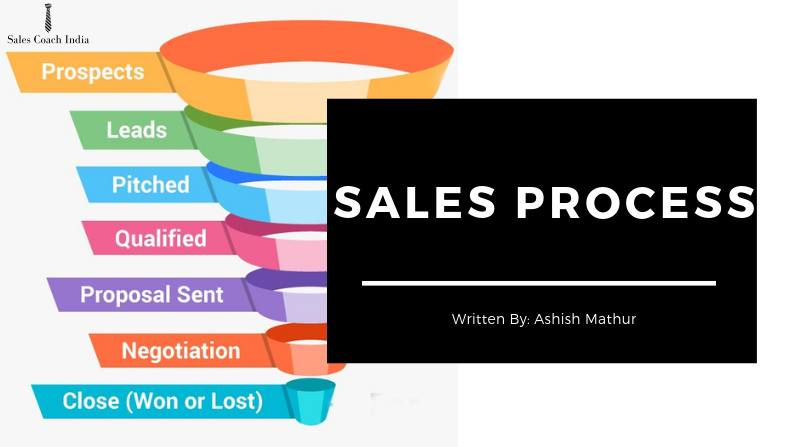
A systematic selling process consists of following ten steps as shown in the diagram:
1. PRE-SALES PREPARATION:
Pre-Sales is the first step of getting prepared to serve customers. A good salesperson must be well prepared to treat the customer effectively. He must be aware of the customer’s buying motives and buying behavior. We have in our earlier blogs already covered that the following essentials of selling must be fully known to him-
2. PROSPECTING:
Prospecting means finding or locating potential customers. It is a process of differentiating prospects and suspects. A prospect is a potential buyer with unmet needs, ability to pay and willingness to buy. It is much easier to prospect for the right customer if you have a marketing plan that determines your target market.
There are three different segments of people in the world of prospecting-
People you don’t know
- Social media
- Network events
- Cold market prospecting
- Friendship farming
- Centers of influence
- Other salespeople
- Use of telephone directories and directories of professional and other associations
- Customer database available, prepared by other companies or agencies.
People you do know
- Your existing customers
- Your past customers
- Shortlisted prospects through cold calling
- Follow up on old leads that never closed.
People your people know
- Data of prospects at HO
- Data of prospects with your Team
- Enquiries sent by prospects either to HO or Team.
One must qualify the prospect in terms of needs, purchasing power and motivation to buy.
3. PRE-APPROACH:
Once prospecting has been done, the sales person has to gather complete details about the prospect. These details are necessary to prepare his sales presentation. These would include information on prospect’s nature, needs, problems, personal habits, preferences, etc.
4. APPROACH & CONTACT:
Now that the sales person is prepared with his pre-approach, he has to seek advance appointment for the personal meeting. The approach could be different on case to case basis. Having a script for an approach call is a MUST. He must not directly jump to sales talk in the approach call. He must be able to attract the prospect’s attention and get him interested in the product.
5. PRESENTATION:
A formal sales presentation must get attention of the prospect and make him interested in the product. The sales person can do it through a lively and interesting sales talk as well as a systematic demonstration of the product. The product could be offered to feel, taste or smell depending on the nature of the product.
Leaks in your presentation– Talking too much and not asking enough questions. If it’s too many statements without questions, you’re not a good presenter. A good presenter is somebody that’s asking relevant questions because you get to find about the customer and his buying needs.
He can produce authentic evidences to prove the product’s superiority. All queries must also be adequately solved.
Qualities of a good presentation:
- Presentation is questions and knowing your craft, knowing your product and generally not B sing people whom you don’t know what you are talking about.
- Sales Presentation must be complete covering all aspects related to company, product, competitive benefits, etc.
- Sales Presentation must be clear, free from all confusions and vagueness.
- Sales Presentation must be consistent.
- Sales Presentation must be precise.
- Sales Presentation must prove superiority of products over competition.
- Sales Presentation must be confidence winning.
- Sales Presentation must be supported with evidences. A good sales person must produce testimonials, awards and guarantees issued by government or test labs, celebrities, and other reliable sources.
Be well prepared– Prepare, prepare, practice, practice and then practice more for an effective presentation. You only have one shot at making a first impression.
6. HANDLING OBJECTIONS & COMPLAINTS:
Address any concerns or objections the prospect may have. Again be prepared- Objection Handling is a step by step process that we shall take up separately in one of my future blog. A sales person, however, must always welcome objections as it shows that customer is interested in the products and is more likely to place an order.
A good sales person must interpret objections clearly and remove them tactfully. Unless the objections and complaints are satisfactorily answered, the sales cannot take place. Prospects must be convinced about benefits, superior performance and strong aspects of the products. A great deal of expertise, experience, skills, patience and practice are important to handle objections successfully.
7. CLOSING SALES:
Closing of sales is the climax or the desired outcome of the entire sales process. Sales Process must end by getting orders. A successful sales person MUST close the sale. He should not wait for the customer to ask for the product-that will never come. He has to “ASK” for the order. A good sales person must summarize what the customer has purchased and agree the deal.
8. FOLLOW UP:
Follow up is a simple two-step process-
- Completion of selling formalities
- Taking other post-sales actions.
A salesperson writes order, arranges for dispatch and delivery of the product and decides on the mode of payment. Billing and guarantee cards are issued. Follow up is 100% discipline-Details are equally important. Details are important as, if you don’t remember the conversation you had with the customer in the first meeting, reflects you do not pay attention to things. But if you do have the discipline to follow up and you do remember the specific details you had with the customer in the first meeting, reflects you value his time.
9. REFERRAL:
Once you have closed sales- do not celebrate. Ask for referrals. Preparing a script for asking for referrals is also important. Asking for referral is setting yourself up for growing your business.
10. MAINTAIN CUSTOMER RELATIONSHIP:
Sales person-customer relationship does not end with one transaction, but is the beginning of a long term relationship. Customers repeat orders only if they are satisfied with products and post-sales services. A great sales person must remain in live contact with the customer for future business.
Studies have proved that if you sell out of sequence, you kill the sale. There is a logical buying process that a customer goes through. You have to get your selling process in line fitting the buying process and the sale is bound to happen.

by admin | Jan 22, 2019 | Aarambh, Prachand, Sales, Uncategorized
Companies may have all ingredients of a mega block buster- clear strategic direction with a great vision, a great product line, competitive prices, the best of positioning and yet it’s growth goals are being constrained by a lack of revenue. Revenue is directly related to sales. .
It’s imperative to find out the source of that problem. Is the sales process flawed? Is there a gap between decisions and execution by the sales team?
The next step is identifying inefficiencies and gaps in the sales process and then training the sales team to overcome these inefficiencies as per their training needs.
Training is the process of increasing knowledge, skills and other traits of an individual for performing a particular job. It’s purpose is to improve the behavior and performance of the trainees.
CONCEPT OF SALES TRAINING
Sales Training can help aspiring sales persons to develop and practice the skills they need to succeed and increase their confidence level.
Businesses have realized the importance of sales training and it’s global market has significantly increased over the years.
The learning objectives of effective sales training programs are generally to improve the relationship between sales professionals and their prospects/customers, and to also improve the sales performance and close rates of sales professionals.
TARGET AUDIENCE (WHO?)
Students of sales training programs are primarily those who work as sales professionals, sales managers, channel sales professionals, product sales professionals, and sales force automation professionals.
THE HOW OF SALES TRAINING
Sales training programs often include topics related to customer relationship management, better understanding customer needs, enhancing communication with customers and improving customer interactions.
- SALES METHODOLOGY TRAINING includes basic communication skills and techniques for sales professionals. the most commonly taught sales methodologies are Spin Selling and Solution Selling.
- SALES MANAGEMENT TRAINING involves skills for how to manage a sales force..
- PRODUCT SALES TRAINING involves knowledge of the products/services the sales professional is selling. A common approach to product sales training is teaching how to communicate the features, advantages and benefits (FAB) of the product to the customer.
- SALES FORCE AUTOMATION involves teaching the sales professionals how to use online tools to track and report the progress of sales activities.
IMPORTANCE OF PROFESSIONAL SALES TRAINING:
PROPER AND A PROFESSIONAL SALES TRAINING IS IMPORTANT FOR A NUMBER OF REASONS:
- IMPROVING COMMUNICATION SKILLS
- LEARNING SALES METHODOLOGY
- OVERCOMING OBJECTIONS
- DEVELOPING ADMINISTRATIVE SKILLS
- PRODUCT KNOWLEDGE
- CUSTOMER SERVICE SKILLS
OBJECTIVES OF SALES TRAINING:
- SALES GROWTH & INCREASED PRODUCTIVITY (SALES PRODUCTIVITY, INCREASED SALES & PROFITS OR BOTH)
- SALES FORCE TURNOVER (TO CREATE POSITIVE ATTITUDE AND TO INCREASE SALES FORCE MORALE)
- REPEAT CUSTOMERS (TO IMPROVE CUSTOMER RELATIONS)
- UP SELL STRATEGIES
- SALES EFFECTIVENESS
- TO INTRODUCE NEW PRODUCTS, MARKET AND PROMOTIONAL PROGRAMS.
THE BEST SALES PEOPLE HAVE The DRIVE TO LEARN AND BE THE BEST.
GOOD SALES TRAINING WILL HELP THEM GET THERE.
INVEST IN IT EARLY ON AND YOU’LL HAVE A TEAM THAT CAN’T BE BEAT.

by admin | Jan 15, 2019 | Aarambh, Prachand, Sales, Uncategorized
Making a career choice is one of the most critical decision one takes that will shape their entire life. Whether you have already chosen sales as your choice of career or you are considering it, here are a few things which will help you make an informed decision.
Spoiler Alert – Sales is not for the faint-hearted.
Life goes on. It simply passes by. We are all to finally fade. But for some amongst us, it is different. For us, life throws up opportunities. Excellence in business is one such opportunity and selling is business.
Selling is an art and like any other performing art, we have a performer- the salesperson and a beholder- the prospect. As an old proverb goes, “Every successful person is a good salesperson”. One can assume that selling comes naturally to some people. But then, how many of us are conscious of the fact that we are good salespersons. To sell naturally is something, but to sell compulsively and effectively is a different proposition. One does need professional skills to sell.
Let us first learn abut the territory we are getting into – sales.
What is selling?
Selling primarily effects transfer of Products and Services for something in exchange-from one person to another. It is a fair Exchange for the satisfaction of Mutual Needs. The Customer’s need for a Product or Service is satisfied by the Sales Person & His organization. In turn, the salesperson gets Business & Profit which is his need.
- Both the Buyer & seller thus have their need satisfied.
- In selling make sure your customer gains so that you also gain.
Any selling activity can be divided into various stages and various sequences and models. The performer has to practice a lot and sharpen his/her skills to avoid chaos during a sales call.
It is elementary that a salesperson gathers complete details of a client and specific requirements.
The significance of gaining the attention of the beholder is the first step in selling.
Building up of interest comes next after having gained attention. Before you give your prospect an optimum exposure of your product knowledge, identify his needs for him and then propose your product or services for him. Create a desire for your products or services. Arouse him. Bring in conviction. Talk of opportunity lost. Bring at a price only if you have to. Timing is important.
Thus, for a successful sales call following is important:
- Attention
- Interest- problem identification & classification
- Desire
- Conviction
- Close
Why Sales?
More and more young people are taking up sales as their career. That one has a knack of initiating a dialogue with anybody anywhere is not the only credential of a salesperson. One has to be initiative and imaginative. Above all one has to develop the skill of being a good listener. Experience teaches all that, plus the ability to give direction to a conversation. Lead the conversation to your goal without diluting the main purpose one bit.
Selling as a career gives you:
- Freedom of expression
- Offers you an opportunity to become successful
- Offers you a challenge every day, at every step, and stimulates you regularly
- Offers rich and high rewards
- Stimulates your personal growth
- Master of your own.
While the emotional rewards range drastically from sales job to sales job, the thrill of victories, the income rewards, the flexibility associated with sales and the learning potential makes choosing a career in sales a very attractive option but yet, not for the faint hearts.


 Ashish Mathur
Sales Coach & Speaker
I help product based businesses fill their sales process leaks to create a flawless, result driven sales process. I also train sales professionals on mastering their sales skills and become sales superstars.
Ashish Mathur
Sales Coach & Speaker
I help product based businesses fill their sales process leaks to create a flawless, result driven sales process. I also train sales professionals on mastering their sales skills and become sales superstars.